|
|
1. Choose and Adjust Frame a. when choosing a frame be aware of your B measurement (frame depth) b. avoid frames that deeply cut away from the nasal (some aviator shapes) c. Adjust nose pads as if dispensing frame d. Adjust temples to straighten horizontal fit (leveling) e. Adjust frame to fit close to eye
Continue reading Accurate Progressive Measurement
This is a very basic and simple approach to explaining aspheric lenses. They feature a different lens design than the standard spherical lens. To understand the aspheric concept, you have to consider two components of a lens that affect how light travels through the lens. The first is the index of refraction and secondly is
Continue reading Aspheric Lens Design
Vitamin A – We all remember our mothers telling us to eat our carrots so we could have eyes like an eagle. Why did our mothers tell us this? What do carrots really do for us?
Carrots contain a carotenoid called beta-carotene. Carotenoids are pigments
Continue reading Nutrition for the Eyes
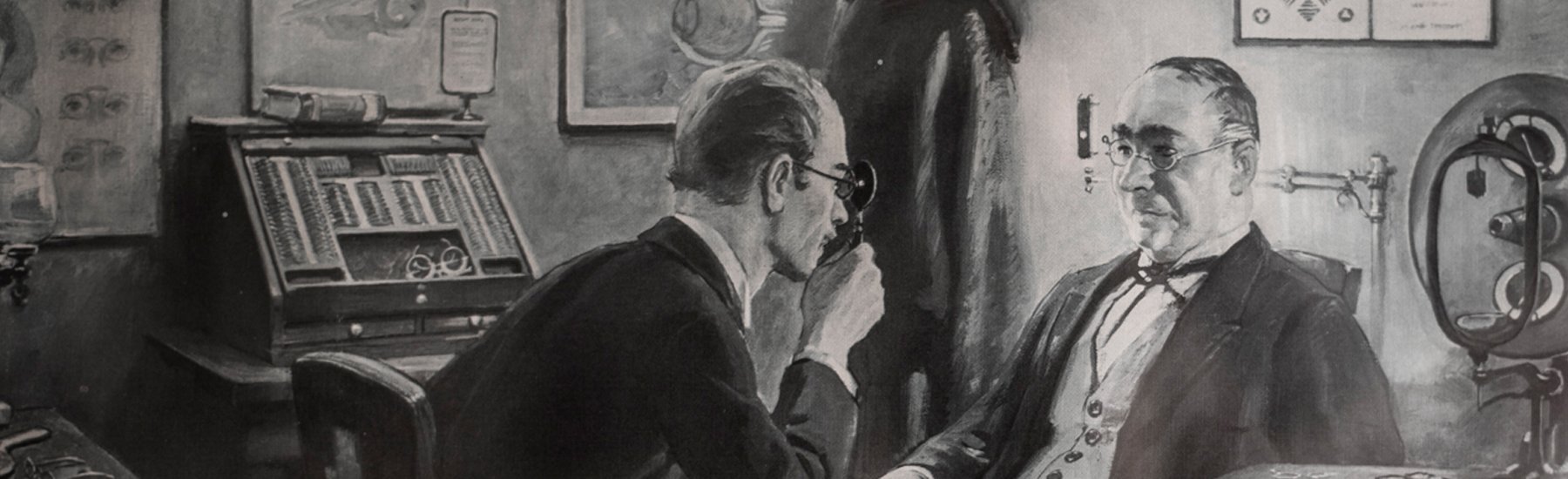
The Development of Opticianry
In early times customers made their selection from a tray of eyeglasses which were already assembled and which contained standardized non-prescription lenses. Today, this same procedure is still followed in some novelty and drug stores where ready made reading glasses are selected from a display. As could be expected the
Continue reading The Development of Opticianry
Responses to Tickle’s inkblot test This is my, Joe, result from an online ink blot test.
By having your unconscious mind driven most by Peace, it appears that you feel a level of comfort with yourself and with your surroundings that many people lack. By having respect for others and caring about the world
Continue reading Ink Blot Test
FACT – UVA & UVB RAYS ARE HARMFUL More and more people are aware of the dangers caused by the sun. Your eyes, as well as your skin are at risk every time you step outside. You can reduce the risks of damaging your eyes by wearing sunglasses.
What does ultraviolet (UV) mean? Ultraviolet is
Continue reading Facts about UV
Different lenses have different properties. The density varies, known as index of refraction, and the ABBE VALUES are different for the various materials. The ABBE VALUE is a number given to describe the amount of chromatic aberration of an ophthalmic lens material. Here is a list of ABBE VALUES. The higher the number, the less
Continue reading ABBE Value Interpretation
By definition an ophthalmic prism is wedge-shaped lens of glass or plastic that is thicker at one edge (the base) than at its opposite edge (the apex). Prisms usually are prescribed to correct faulty eye-muscle imbalances in which both eyes do not act as a team. In these cases, the refractive doctor prescribes the proper
Continue reading Prism
Tints, Filters and Sunglasses
Tinted lenses are worn for the sake of appearance, comfort (discomfort glare), vision (disability glare) and protection against UV exposure. Sunglasses typically reduce transmission to 15%-25% and can be even darker for very bright conditions such as snow. At least 8% transmission is required to drive a car safely. Wearing
Continue reading Tints, Filters and Sunglasses
The Issue of Adaptation
“These aren’t working for me.” This isn’t what we want to hear from our patients. Before you fit progressives, please consider the following variables and realize that adaptation issues are a challenge that every Optician faces.
If working with a multifocal patient,
Continue reading Issue of Adaptation
|
|
Optical Spectrum Comments